


Made in Germany · ISO 27001 · GDPR-compliant
Training Management
Plan, Conduct, and Document Mandatory Training Digitally
Most companies provide training to their employees. The problem rarely lies in the training itself, but rather in maintaining records: Who needs to be trained on which topic and when—across locations, job functions, new hires, personnel changes, and deadlines? It’s not until an audit or after a workplace accident that it becomes clear whether Excel spreadsheets and paper signatures were sufficient.
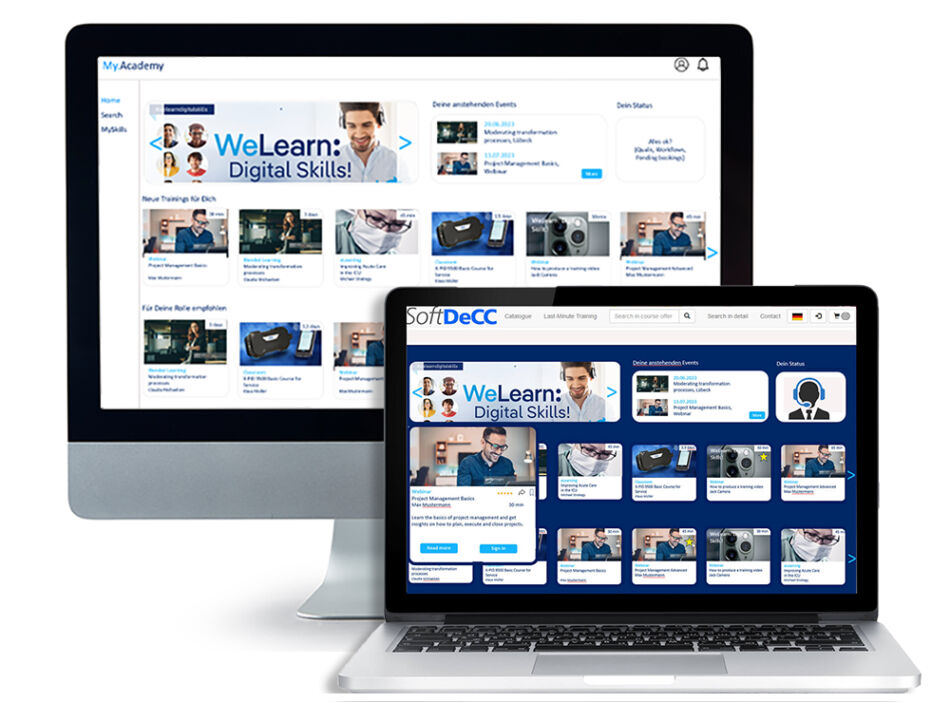
SoftDeCC makes training sessions easy to plan: Mandatory training sessions are automatically assigned, repeated on schedule, and fully documented—whether online, in person, or a combination of both.
Note: This article provides a practical overview and is not a substitute for legal advice.
Skills Development
Assessment
Certification


Orientation
Overview of Legal Bases
In addition, there are industry-specific requirements, such as those in the energy sector or in medical technology. → LMS for Energy & Utilities · → LMS for Medical Technology
Relevance
Is it permissible to teach online?
Yes—under certain conditions. Electronic training is permitted if the content is specific to the job, understanding is verified, and employees can ask questions of a knowledgeable person at any time.
Where regulations require verbal or hands-on instruction—such as for hazardous materials or specific machinery—e-learning does not replace on-site instruction. A blended approach has proven effective: General content is delivered and tested digitally, while job-specific training is provided in a concise, on-site format and documented within the same system. → LMS for Blended Learning
Typical Challenges
Why Training Without a System Fails
✓
Deadlines can be easy to lose track of: annual, semiannual, and event-specific training sessions all take place at the same time.
✓
New hires and job changes are not recognized: The obligation to provide training arises immediately, but the information often reaches the safety officer too late.
✓
Temporary workers fall through the cracks: They aren't in the HR system, but the host company is still responsible for providing them with training.
✓
Records are scattered: paper lists, Excel spreadsheets, and emails stored in various locations.
✓
Language barriers: Instructions that are not understood do not serve their purpose—and are legally vulnerable.
✓
Managers Lack an Overview: Those in charge often don't see which members of their own team are behind schedule.
Functional Requirements
Features for Effective Training Management
Proven in practice
Here's how a training cycle works in SoftDeCC
Definition and Meaning
Instruction, Training, Compliance Training—What's the Difference?

Checklist
Requirements for Training Software
☐
Assignment by Role, Job, Location, and Department
☐
Customized review intervals for each training session
☐
Automatic Triggering Upon Entry and Change of Activity
☐
Onboarding Temporary Workers Without an HR Master Record
☐
Digital and In-Person Training in a Single System
☐
Comprehension test with documented results
☐
Multilingual Content
☐
Reminders and Escalations to Managers
☐
Audit-ready documentation, exportable
☐
Role-based visibility, coordinated with the works council
☐
A hosting model tailored to your data protection requirements
Get More Information for Free Now
Training that stands up to an audit
See for yourself in a test installation how SoftDeCC automatically assigns, tracks, and documents your mandatory training sessions.
✓
Over 25 Years of Expertise
✓
Made in Germany
Frequently Asked Questions
