


Made in Germany · ISO 27001 · GDPR-compliant
How much does an LMS, course management system, or skills management software cost?
Comparison of Licensing Models and Pricing Structures for LMS, Seminar Management, and Skills Management
Today, the question of how much a learning platform costs can no longer be answered simply by citing a license price. Modern learning software often encompasses far more than a traditional learning management system.
At the same time, the market is changing: While fixed license fees used to be the main focus, usage-based models are becoming increasingly important. Today, LMS costs arise not only from user licenses, but also from course enrollments, automation, API usage, AI features, tokens, or credits.
Anyone looking to evaluate educational software should therefore not focus solely on the initial price. The total cost of ownership (TCO) over the entire lifecycle and the specific benefits for the organization are the key factors.
License Fees
Fixed Costs
Tokens / Credits
SLAs


Changes in Cost Structures
Why the Pricing Models for Educational Software Are Changing
The market is shifting from rigid licensing models toward more flexible, usage-based approaches. At the same time, learning platforms are becoming more comprehensive—in addition to learning content, they are often expected to support seminar and training management, qualification management, skill management, certificate administration, compliance documentation, learning recommendations, reporting, and AI-powered processes. This gives rise to new cost categories, but also new opportunities for automation.
Classification by Software Type
What types of educational software are there?
LMS & Learning Platform
An LMS supports the administration, delivery, and documentation of training and e-learning initiatives. A learning platform expands on this by offering personalized learning paths, social learning, and knowledge management.
Seminar Management Software
Supports the planning, organization, and execution of in-person, online, and hybrid events: scheduling, resource management, instructor management, participant management, registration processes, waiting lists, certificates, and invoicing.
Skill and Qualification Management
A global budget enables strategic resource allocation, ensuring that skills development contributes to overarching corporate goals—with centralized management and prioritization.
A related misconception concerns the choice of system itself. Read on to find out why a traditional ERP system is usually not the right choice for training.

TCO - Total Cost of Ownership
What types of costs are associated with educational software?
When making a selection, companies should consider the total cost of ownership (TCO)—all costs over the entire useful life.
✓
One-time costs for implementation and rollout: implementation, configuration, customization, data migration, training, project management, testing, and interface connections. The effort involved depends on how many processes are mapped and the depth of integration with existing systems.
✓
Recurring fixed costs: software licenses, SaaS fees, hosting, maintenance, updates, support, and SLAs. With cloud solutions, many services are already included—it’s worth taking a closer look at which services are included and which are optional.
✓
Usage-based costs are based on active users, seminar bookings, course completions, transactions, API calls, automations, and tokens/credits. High flexibility, but potentially higher total costs as usage grows rapidly.
✓
Hidden costs —such as content maintenance, process adjustments, reporting adjustments, governance tasks, interface maintenance, user management, and internal change management—are often underestimated in budget planning.
Funding Opportunities
Finance the LMS implementation through the KfW subsidy loan
In Germany, the implementation of a learning platform can be financed through KfW’s ERP Digitalization Subsidy Loan (Programs 511/512). The “LevelUp-Digitalization” funding category explicitly covers the acquisition and implementation of digital training systems. This also includes continuing education for employees—including their personnel costs—and the digital transfer of knowledge within the company.
Whether your project will receive funding—and, if so, in what amount—is determined by KfW and your primary bank on a case-by-case basis. You can find the current terms and conditions and the information sheet on the KfW website.
As of October 2026. Funding requirements are subject to change.
The loan is available not only to small and medium-sized enterprises but also to larger medium-sized companies with group revenue of up to 500 million euros. Up to 100% of eligible costs can be financed. These include software, implementation, external consulting, and internal project costs. In addition, KfW provides a grant equal to a percentage of the loan amount disbursed.
In practice, two points are important:
• Submit the application before the project begins. Der Antrag läuft über die Hausbank und muss vor Beginn des Vorhabens gestellt werden, also vor der verbindlichen Bestellung.
• Be able to describe the project. The bank requires a project description that includes the current and target states. A structured requirements specification provides the basis for this. → Create your free requirements specification here
When is automation worth it?
How much do manual processes cost?
The actual cost-saving potential often stems not from the software itself, but from the digitization and automation of processes—particularly in the areas of seminar planning, participant communication, certificate management, recertification, proof of qualifications, audit preparation, skill assessment, and compliance documentation.
Pros and Cons of Pricing Models
Comparison of the Main Pricing Models
In practice, hybrid models—which combine fixed base costs with usage-based components—are now the norm.
Usage-Based Costs
Tokens, Credits, and Usage-Based Costs
Modern platforms are increasingly integrating generative AI, intelligent search, skill analytics, automated content creation, translations, reporting services, and workflow automation—billed based on usage units rather than traditional licenses.
For companies, this means that not only licensing costs but also the expected frequency of use should be factored into budget planning.
Holistic Learning Environment
The Importance of a Learning Ecosystem
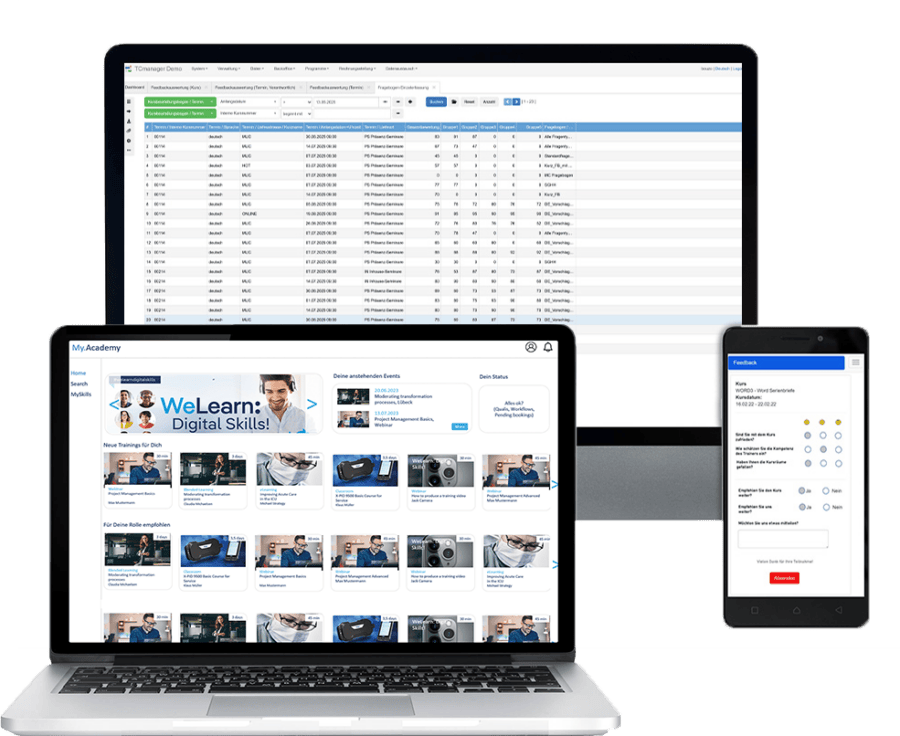
Today, many companies are no longer looking for a standalone system, but rather an integrated learning ecosystem: learning management, training management, skills and qualifications management, analytics and reporting, and AI services. The LMS costs of a platform should therefore always be considered in the context of the entire scope of the process—not in isolation as license costs.

A Nuanced Decision
Evaluation of Skills and Qualifications Management
While an LMS often pays for itself through reduced administrative costs, the economic benefits of skills and qualifications management often arise elsewhere: greater transparency regarding competencies, more targeted professional development initiatives, better workforce planning, faster filling of critical roles, lower compliance risks, greater auditability, and improved workforce readiness. The cost-benefit analysis should therefore not be limited solely to learning costs.
Basic Criteria
Purchase Criteria for Selecting Educational Software
Number of users
How many users will actually be active? It is not registered users, but active users, who often determine the actual costs.
Processes
Which processes should be supported? Just learning, or also seminars, certifications, and skills?
APIs & Interfaces
What integrations are required? Integrations with HR, ERP, or identity management systems have a significant impact on total costs.
Usage Volume
Which features will result in future operating costs? Be sure to evaluate AI services, automation, and external services early on.

Conclusion
It's not the license price that matters
Today, the question is no longer, “How much does an LMS cost?” but rather, “What are the total costs associated with learning, seminars, certifications, and skills—and which pricing model is the best fit for the organization?”To make an informed decision, companies should not only compare software costs but also consider the total cost of ownership and the long-term business benefits. SoftDeCC can be implemented in a modular fashion—from learning management and seminar management to comprehensive skills and qualifications management.
Get More Information for Free Now
Discover SoftDeCC educational software now
In just 30 minutes, learn what the SoftDeCC Composable Learning Ecosystem has to offer and how you can calculate efficiently, securely, and cost-effectively.
✓
Over 25 Years of Expertise
✓
Made in Germany
Frequently Asked Questions
