


Made in Germany · ISO 27001 · GDPR-compliant
AI-Based LXPs: Quality, Data Privacy, and Ethics
What Quality, Data Protection, and Ethics Mean for Businesses
Anyone who implements an AI-based Learning Experience Platform (LXP) is investing in learning infrastructure—and taking on responsibility. For learners, because AI recommendations directly guide their skill development. For the company, because GDPR compliance and algorithmic fairness are legal requirements, not optional features.
This article provides training administrators and L&D decision-makers with a structured framework: from quality requirements for training datasets to ethical development principles and compliance with the GDPR and the EU AI Act—including a practical checklist.
Learning Recommendations
EU AI Act
Data Collection
Tracking


Definition
Introduction to Learning Experience Platforms
Today, LXPs are a central component of the learning infrastructure for training centers, academies, and human resources development. Their value stands or falls with the quality of the AI used—which depends on three factors: the quality of the training datasets, consistently applied ethical development principles, and compliance with data protection laws.
Errors in these areas not only lead to inaccurate learning recommendations, but can also result in compliance risks and GDPR violations.
AI and the Learning Experience
How does an AI-based LXP work?
LXP Algorithms and Personalization
AI algorithms analyze learning behavior, competency profiles, and interaction patterns to dynamically recommend learning content.
Training Datasets as a Basis for Quality
The quality of any AI recommendation depends directly on the quality of the underlying training data—incomplete or biased datasets lead to inaccurate or unfair recommendations.
Overview of AI-Powered LXP Development
The development of an AI-based learning experience platform brings together several areas of technology, each with its own specific quality requirements. Anyone procuring or operating an LXP should be familiar with these components in order to evaluate vendor claims from a technical perspective.
Technological Advances and AI Integration
Challenges in LXP Development
References
What Our Customers Say
TCmanager LMS offers everything you would expect from a software tool for training centers. Today, our extensive training offerings for our service and sales partners and customers are optimally supported worldwide by training portals tailored to specific target groups and countries. The management of schedules, bookings, and resources is logically structured and intuitive to use. Reports can be generated quickly and clearly at any time. SoftDeCC is our reliable partner, with whom we will continue to deliver our in-person training and e-learning offerings in the future.

YASKAWA has been a customer and user of TCmanager® since 2015. After an extensive search for a management tool for our training and continuing education division, we are now glad—following its implementation—that we chose SoftDeCC. It quickly becomes clear that this software was specifically designed for training and qualification management. We’re discovering far more capabilities than we initially required or expected. We’re confident that TCmanager® will help us position our training programs well for the future and improve our efficiency and quality.

SoftDeCC did an excellent job of bringing to life the high standards we set for functionality on the one hand and user-friendliness on the other through customized solutions. The expert advice and support, as well as the constructive and solution-oriented discussions, were particularly helpful in this regard. The collaboration has been excellent, thanks to the very pleasant working relationship and high level of reliability.

For more than 30 years, training and education for Schneider Electric’s customers and partners have been closely linked to quality and reliability. In 2019, we chose SoftDeCC’s TCmanager® LMS (Learning Management System). The support we received from SoftDeCC during the implementation phase was extremely helpful. Since then, the learning system’s feature set has been continuously expanded, offering more options to meet our growing needs. The SoftDeCC team is very familiar with our application and has been a great help!

Hella Academy provides technical training to repair shops and retail partners on our products, as well as on specialized topics such as “Hybrid & High-Voltage” and driver assistance systems. We have been a satisfied customer and user of theTCmanager® LMS since 2015. We are particularly impressed by the support time and again. Any customizations or new features we request for the application’s functionality are implemented smoothly and help us better serve our customers.

Quality Requirements for Training Datasets
The quality of an AI-based LXP stands or falls on the quality of its training datasets. Two aspects are particularly relevant in this regard: data protection and fairness.
Data Privacy in Training Datasets
Fairness and Avoiding Bias
Regular bias audits and the use of diversity metrics in the selection of training data are necessary to identify and correct systematic biases.
Ensuring Ethical LXP Development
Ethical principles remain ineffective unless they are translated into concrete, verifiable processes. Three key elements are essential for this:
Ethics, Law, and Compliance in LXP Development
Ethics as a Guiding Principle
Ethics in LXP development means designing AI-powered learning recommendations in a way that supports learners rather than limiting them, respects individual development, and does not convey implicit value judgments about performance.
GDPR and the EU AI Act: Legal Requirements
AI-powered learning systems process a significant amount of personal data—learning histories, competency profiles, and interaction patterns. As a result, they fall directly within the scope of the GDPR.
Article 22 of the GDPR governs automated individual decision-making: If an LXP algorithmically generates learning paths or recommendations that significantly influence an employee’s career development, the rights to transparency and to object apply. Articles 13 and 14 of the GDPR govern the information requirements for data collection.
The EU AI Act (Regulation 2024/1689) took effect on August 1, 2024, and classifies AI systems in the education sector as potentially high-risk. Important for understanding the timeline: The specific requirements for high-risk systems under Annex III—technical documentation, human oversight, and logging—will not become mandatory until August 2, 2026; they do not apply as of the Regulation’s entry into force.
Requirements for affected systems include: technical documentation of the AI methodology, ensuring human oversight of automated recommendations, verification of data quality and the representativeness of the training data, and comprehensive logging and monitoring requirements.
For L&D decision-makers, it is important to note that these requirements should be included in the specifications for an LXP procurement and confirmed in writing by the provider.
GDPR and the EU AI Act: Legal Requirements
Guidelines for handling ethically sensitive learning content help ensure that LXP platforms respect societal values and do not promote one-sided worldviews.
Correcting Undesired Results
Even carefully developed AI models occasionally produce undesirable or distorted results. What matters is not the absence of errors, but a robust correction process.
LXP Checklist
Checklist for Training Administrators and Human Resources Development
For specific implementation decisions, it is also recommended to involve data protection officers and—in light of the EU AI Act—to seek expert legal advice.
☐
Review data protection measures: Anonymize or encrypt sensitive data. Configure and document access rights. Clarify GDPR requirements (Articles 13, 14, 22) in writing with the LXP provider.
☐
Take the EU AI Act into account: Review the risk classification of the LXP system being used. Contractually agree on technical documentation, logging, and human oversight. Incorporate these requirements into the specifications before awarding the contract.
☐
Ensuring Fairness: Regular bias audits. Diversity metrics in training data selection.
☐
Expected benefits for learners: A personalized learning experience. Flexibility in learning paths and pace.
☐
Expected benefits for the organization: Skill tracking for data-driven analysis of skill gaps. Learning analytics as a management tool. Efficient use of resources through targeted skill development paths. Comprehensive proof of compliance for regulated industries.
☐
Adhere to ethical and legal standards: Clear guidelines and regular compliance reviews. Emergency procedures for incidents involving bias.
☐
Establish transparent processes: Keep records of training datasets. Inform learners about the use of AI and their data protection rights.
☐
Continuous evaluation: Regular review of AI models. Mechanisms for automatic model monitoring.
☐
Quick action when results are unsatisfactory: Systematic audits. Actively utilize feedback loops from learners and trainers.
Conclusion
AI-Based LXP
High-quality AI-based LXPs are not a sure thing. They require valid training datasets, ethical development principles, GDPR-compliant data processing, and structured correction mechanisms for undesirable results.
Skill tracking and learning analytics provide the added value that sets LXPs apart from simple content libraries: measurable competency development that can be strategically managed by HR and training administrators.
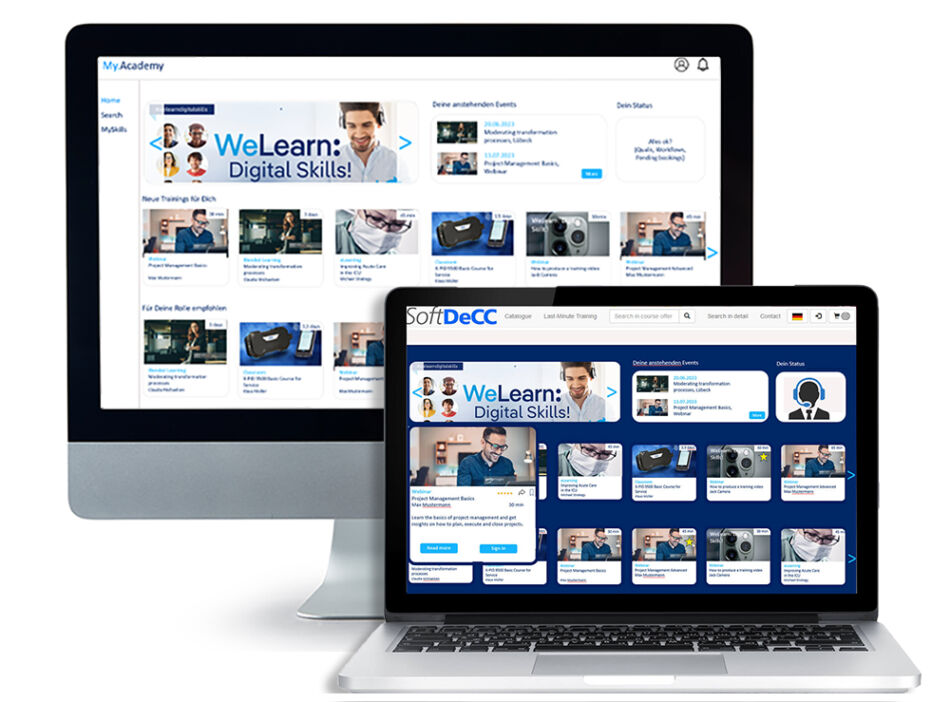
SoftDeCC LXP was developed based on these principles—with transparent data processing, configurable access rights, and a system architecture that adapts to the specific requirements of training centers and compliance-driven industries.
Get More Information for Free Now
Discover SoftDeCC LXP Now
In just 30 minutes, learn how SoftDeCC LXP and TCmanager® can make your training programs—including individual continuing education courses—more relevant and personalized, leading to greater learning success in corporate learning.
✓
Over 25 Years of Expertise
✓
Made in Germany
Frequently Asked Questions
