


Made in Germany · ISO 27001 · GDPR-compliant
Open Source vs. Commercial LMS: What Really Matters
At first glance, open-source LMSs seem attractive—the software is free, and the source code is open. But anyone who objectively calculates the total costs, implementation effort, and long-term operational reliability usually comes to a different conclusion. This article highlights where the hidden costs lie, the risks that open-source systems pose for companies without their own in-house IT development capabilities—and when a commercial solution is more worthwhile.
Hidden Costs
TCO
Security
Security


"Free" Doesn't Mean "No Cost"
The software itself is free. That’s true. But implementing, customizing, hosting, and maintaining an open-source LMS requires experienced developers—and they don’t come for free. Companies that rely on low-cost freelancers or students risk incomplete implementations and a lack of continuity in maintenance. If the original developer leaves the project, companies are often left with a system that no one knows how to use anymore.
What commercial LMSs offer: clear, contractually defined pricing models that include hosting, updates, maintenance, and support—predictable total costs with no hidden additional fees.
Open Source in Practice
Limits to the Flexibility of Open-Source LMSs
In theory, open-source LMSs can be customized in any way. In practice, however, this is only possible with a well-coordinated team of developers. Without this foundation, customizations take longer than planned, cost more than expected—and the quality suffers.
What commercial LMSs offer: extensive configuration options via user-friendly interfaces, modular extensions that the provider tests and keeps up to date—without the need for in-house development expertise.

References
What Our Customers Say
TCmanager LMS offers everything you would expect from a software tool for training centers. Today, our extensive training offerings for our service and sales partners and customers are optimally supported worldwide by training portals tailored to specific target groups and countries. The management of schedules, bookings, and resources is logically structured and intuitive to use. Reports can be generated quickly and clearly at any time. SoftDeCC is our reliable partner, with whom we will continue to deliver our in-person training and e-learning offerings in the future.

YASKAWA has been a customer and user of TCmanager® since 2015. After an extensive search for a management tool for our training and continuing education division, we are now glad—following its implementation—that we chose SoftDeCC. It quickly becomes clear that this software was specifically designed for training and qualification management. We’re discovering far more capabilities than we initially required or expected. We’re confident that TCmanager® will help us position our training programs well for the future and improve our efficiency and quality.

SoftDeCC did an excellent job of bringing to life the high standards we set for functionality on the one hand and user-friendliness on the other through customized solutions. The expert advice and support, as well as the constructive and solution-oriented discussions, were particularly helpful in this regard. The collaboration has been excellent, thanks to the very pleasant working relationship and high level of reliability.

For more than 30 years, training and education for Schneider Electric’s customers and partners have been closely linked to quality and reliability. In 2019, we chose SoftDeCC’s TCmanager® LMS (Learning Management System). The support we received from SoftDeCC during the implementation phase was extremely helpful. Since then, the learning system’s feature set has been continuously expanded, offering more options to meet our growing needs. The SoftDeCC team is very familiar with our application and has been a great help!

Hella Academy provides technical training to repair shops and retail partners on our products, as well as on specialized topics such as “Hybrid & High-Voltage” and driver assistance systems. We have been a satisfied customer and user of theTCmanager® LMS since 2015. We are particularly impressed by the support time and again. Any customizations or new features we request for the application’s functionality are implemented smoothly and help us better serve our customers.


Security and Compliance
Open-source users are responsible for security updates, GDPR compliance, and data integrity. If patches are not applied in a timely manner, security vulnerabilities arise—which can have significant compliance consequences in regulated industries such as pharmaceuticals, automotive, and finance.
What commercial LMSs offer: Dedicated provider teams handle security updates, compliance audits, and data protection requirements.
Pitfalls
Common Challenges in Operating an Open-Source LMS
Significant use of resources and time
Infrastructure development, system configuration, and interfaces with HR and ERP systems require in-depth technical knowledge. Those who outsource this work at a low cost often end up with one-off solutions that cannot be further developed.
Support: Community Forum Instead of a Contractual Response Time
Community forums, wikis, and volunteer developers are the only resources available—with no guarantee of response time or the quality of solutions. During periods of high demand, such as during mandatory training sessions, this can become a critical issue.
Scalability requires more than just configuration
Every expansion to meet growing demands requires development work and ties up resources that are usually needed for core tasks.
How do I choose an LMS? Read more about objective LMS quality criteria and a critical analysis of terms such as "validated LMS."
Advantages of Commercial Learning Management Systems
What Commercial LMSs Do Better
Years of development—ready to use right away
Actively further developed and tested in real-world business environments, known bugs fixed, edge cases addressed.
System Integration Without Custom Development:
Standardized interfaces to HR, CRM, and ERP systems via defined APIs and proven connectors.
Continuous innovation without having to invest in in-house development
New learning formats, AI-powered recommendations, mobile learning portals, automated learning paths—providers are constantly investing, and companies are reaping the benefits.
Recommendation
Who would benefit from a commercial LMS?
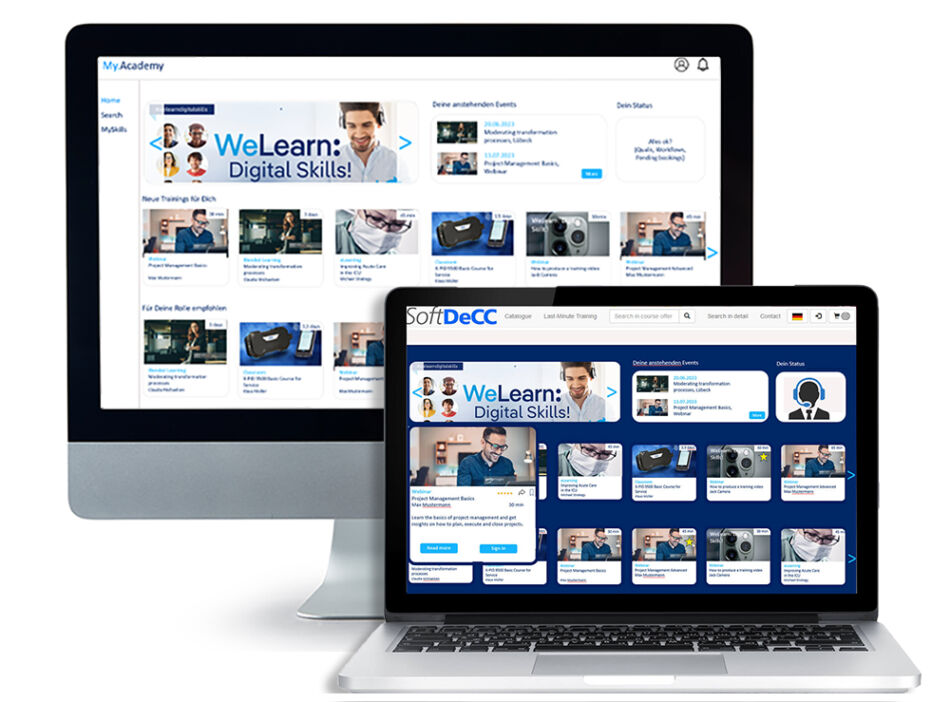
For companies that want to become productive quickly, lack their own IT development capacity, and need predictable costs, a commercial LMS is the clearer choice. The supposed cost advantage of open-source systems evaporates as soon as implementation costs, support expenses, and security risks are factored in.
Training centers and corporate academies that want to focus on learning content and learning outcomes—not on system administration—are often better served by a commercial LMS.
Detailed Comparison of Open-Source LMS vs. Commercial Learning Management Systems
Head-to-Head Comparison: Open Source vs. Commercial LMS
Get More Information for Free Now
Open-source LMS or commercial?
Carefully compare the pros and cons of open-source LMSs and commercial learning management systems.
In just 30 minutes, we'll show you how SoftDeCC LMS and TCmanager® can help your educational organization move forward.
✓
Over 25 Years of Expertise
✓
Made in Germany
Frequently Asked Questions
