


Made in Germany · ISO 27001 · GDPR-compliant
Self-Directed Learning in the Workplace
Help employees grow on their own terms—flexibly, individually, and in line with your company's goals.
Self-directed learning gives employees the opportunity to choose learning content, pace, and learning paths that suit their individual needs. Learning platforms such as LMS and LXP provide the necessary infrastructure for this and align individual learning needs with strategic competency development.
Personalized learning paths, diverse learning formats, and continuous monitoring foster motivation, flexibility, and the development of relevant skills —while enabling companies to tailor learning processes specifically to their competency needs.
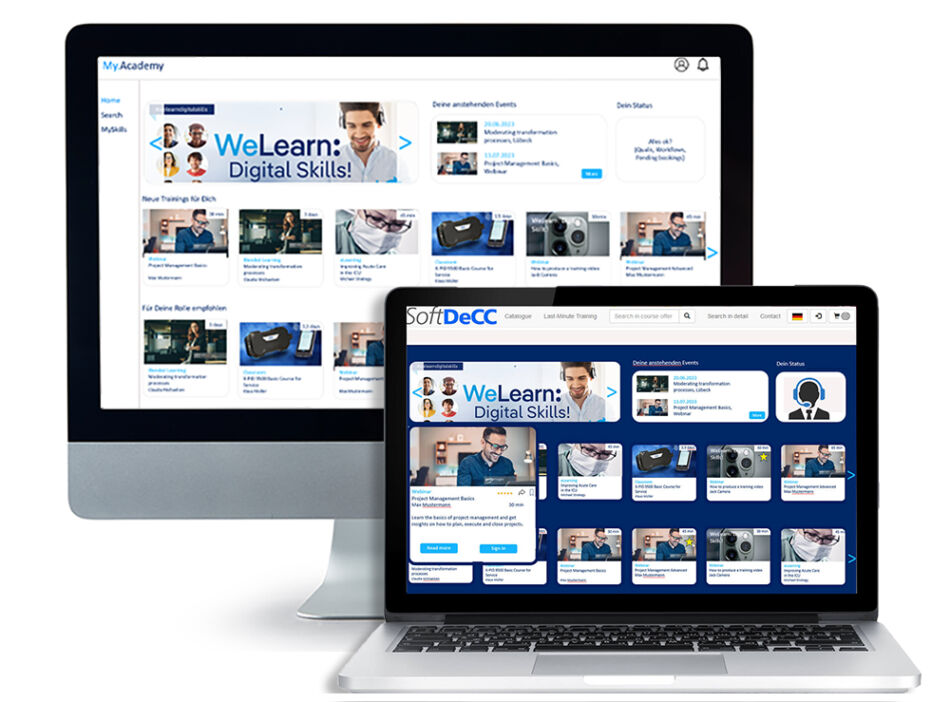
From individual learning initiatives to strategic competency development: SoftDeCC supports self-directed learning with a flexible and integrated learning infrastructure.
Skill Development
Moments of Need
Personalized Learning Opportunities


What's this about?
Self-Directed Learning in the Workplace
In an ever-changing business world, lifelong learning among employees is essential to remaining competitive. Self-directed learning, supported by learning technology platforms such as Learning Experience Platforms (LXPs) and Learning Management Systems (LMSs), has become a crucial component of employee development.
This article shows how self-directed learning can align with a company’s strategic direction, what benefits it offers, and how typical objections can be addressed.
Definition • Characteristics
What is self-directed learning?
Self-directed learning is a learning method in which learners take responsibility for their own learning process and actively work to acquire knowledge and skills. Unlike traditional classroom instruction, where the content and sequence are predetermined and the training is led by instructors, in self-directed learning, learners have control over how, when, and where they learn.
Characteristics of self-directed learning:
✓
Personal Responsibility: Learners choose their own learning goals, methods, and resources.
✓
Self-regulation: Learners plan, organize, and monitor their own learning process.
✓
Flexibility: Flexible in terms of time and location—during work hours, in your free time, or from home.
✓
Personalization: Each learner chooses their own learning path based on their individual needs and prior knowledge.
✓
Motivation: Having control over one's own learning process typically increases motivation.
✓
A variety of learning resources: books, online courses, videos, podcasts, and hands-on exercises.
Advantages
Why Self-Directed Learning Is Important for Businesses
• Flexibility: Employees learn whenever and wherever it suits them best.
• Relevance: Individual learning paths focus on skills and competencies that are actually relevant.
• Efficiency: Learners work at their own pace.
• Motivation: Personal responsibility fosters motivation.
• Agility: Companies can quickly adapt learning content to changing requirements.

Education Strategy
Self-Directed Learning and Corporate Strategy
Self-directed learning in a corporate context requires careful alignment with corporate strategy to ensure maximum effectiveness. Five steps for integration:

Education Budgets - Concepts
Benefits of Education Budgets at Various Levels
Goal-Based Learning
The LMS module enables clearly defined learning objectives that employees can use as a guide.
Gamification & Skills
Completed content and tests can be linked to certifications to track progress for learners, managers, and HR.
Real-time analysis:
Dashboards provide insight into learning progress across all teams.
Recommendation Algorithms
Based on learning objectives, educational history, and skill profiles, the LXP component recommends appropriate courses and resources—targeted skill development rather than random selection.
Freely Accessible Media Library
The SoftDeCC Media Library offers instructional videos, podcasts, and educational resources without requiring registration—exactly the kind of low-barrier access that supports self-directed learning in everyday life.
Objections and Solutions
Common Objections to Self-Directed Learning—and Possible Solutions
"Employees lack the discipline needed for self-directed learning."
Not everyone has the same level of self-discipline. This is where corporate culture plays a crucial role: clearly communicating company goals and offering targeted incentives for professional development promote personal responsibility and lifelong learning.
"Employees are overwhelmed by the wide variety of options."
Without guidance, a wide range of learning opportunities can seem overwhelming. Structured learning paths and development plans, as well as system-generated recommendations for relevant content, make it much easier to get started.
Support Development
Promoting Self-Directed Learning—Without Administrative Hurdles
1. Removing Administrative Barriers
• Streamline and accelerate approval workflows for learning activities to promote greater autonomy.
• Easy access to learning resources, without complicated application procedures.
• Allow for flexible learning time during the workday.
2. Combining Study and Work Time
• Train employees in effective time management.
• Set aside specific time slots for learning activities during work hours.
3. Foster Motivation
• Link clear learning objectives to employees’ career goals.
• Recognize and reward active participation in self-directed learning.
• Promote peer-to-peer learning in which employees share knowledge.

Checklist
Establishing Self-Directed Learning in the Workplace
☐
Are learning objectives clearly defined and aligned with the company's goals?
☐
Are competency needs systematically identified, rather than offering training programs based on gut feelings?
☐
Can employees access relevant learning materials without having to go through complicated approval processes?
☐
Are there structured learning paths and recommendations that help prevent students from feeling overwhelmed by the wide variety of options?
☐
Are peer-to-peer learning and knowledge sharing an active part of the learning culture?
☐
Is learning progress made visible and recognized?
Get More Information for Free Now
Promote self-directed learning now
In just 30 minutes, learn how to use SoftDeCC LXP and the media library to organize your corporate learning in a more personalized and efficient way.
✓
Over 25 Years of Expertise
✓
Made in Germany
Frequently Asked Questions
