
Enterprise LMS for Complex Learning Structures
The Ideal Enterprise LMS for Large Organizations
Large enterprises operate with layered structures, multiple roles, and defined responsibilities:
Learning processes are closely tied to departments, hierarchies, and governance requirements.
An enterprise LMS must manage this complexity rather than simplify it.
TCmanager® is designed to make complex organizational structures operationally manageable.
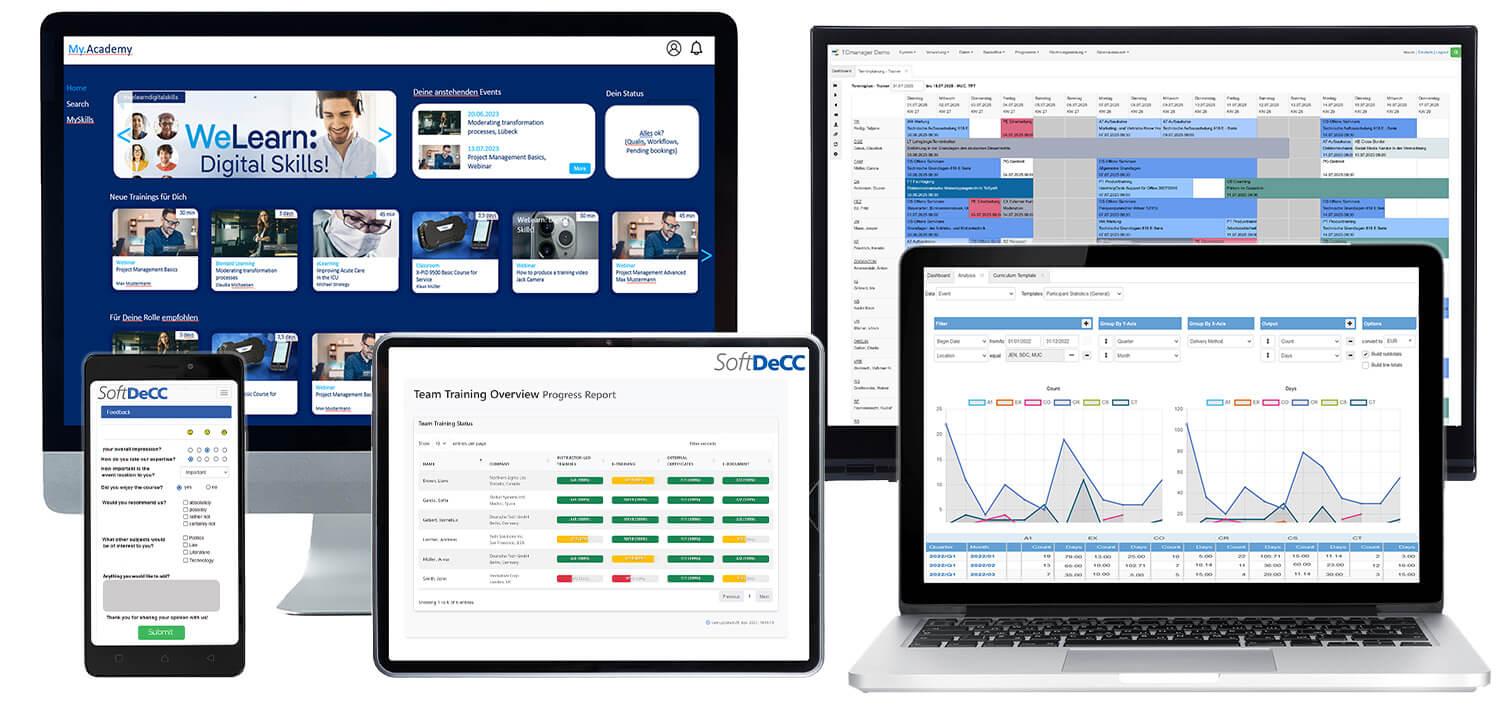
TCmanager® Enterprise LMS helps large organizations centralize learning administration, automate recurring tasks, and maintain control across complex roles, workflows, and data structures.
With automation robots, system integration, and AI-driven support, the platform becomes more valuable as data volume and operational complexity increase.


Why standard LMS platforms fail in large enterprises
Many LMS platforms perform well in smaller environments.
In large organizations, requirements extend far beyond course delivery.
Complex approval processes, role-based control, and cross-system data flows become essential.
Without these capabilities, an LMS becomes an operational bottleneck.

Scalable learning operations for high user volumes
An enterprise LMS must handle thousands of users, training events, and status updates simultaneously.
As usage increases, administrative effort grows disproportionately.
Manual processes lead to delays, errors, and inconsistencies.
Scalability therefore depends on efficient process execution, not just system performance.
Central governance with decentralized control
Large organizations require a balance between central governance and local flexibility.
An enterprise LMS must enforce structure while allowing operational autonomy.
Role-based access and structured workflows enable this balance.
This ensures consistent learning operations across the entire organization.



Automation in enterprise LMS reduces operational workload
Recurring tasks such as assignments, notifications, and updates occur at scale.
Without automation, these tasks consume significant resources.
Automation enables reliable execution of rule-based processes.
This reduces manual effort while improving operational consistency.
System integration as a foundation for enterprise LMS
An enterprise LMS must integrate with existing enterprise systems.
This includes HR systems, identity management, and ERP platforms.
Integrated data flows ensure consistency and reliability across systems.
TCmanager® supports this through flexible integrations and automated processes.
AI in enterprise LMS for data-driven operations
Large enterprises generate complex and high-volume learning data.
AI helps identify patterns and extract actionable insights.
This supports prioritization and decision-making in learning operations.
The value of AI increases with data scale and system complexity

Enterprise LMS evaluation checklist
An enterprise LMS must support large user bases without performance issues. It must handle complex roles and permissions effectively. Automation and integration should be core capabilities. Reporting, auditability, and long-term maintainability are essential.
| Criterion |
What an enterprise LMS must support |
Why it matters for large enterprises |
| Scalability |
Support for large user bases, high training volumes, and parallel processes |
Large organizations continuously increase users and training demand |
| Roles and permissions | Flexible configuration of roles, access rights, and responsibilities | Complex organizational structures require precise control |
| Workflow management | Configurable workflows for approvals, assignments, and training processes | Standardized workflows improve efficiency and reduce errors |
| Automation | Automated handling of recurring tasks such as assignments and notifications | Reduces manual workload and ensures scalability |
| System integration | Integration with HR systems, identity management, and ERP platforms | Ensures consistent data and seamless processes across systems |
| Data consistency & synchronization |
Automated data exchange between connected systems |
Prevents inconsistencies and redundant data maintenance |
| Reporting & analytics | Detailed insights into training activity, progress, and usage | Supports data-driven decision-making |
| Auditability | Full traceability of learning activities and changes | Critical for compliance and internal governance |
| Governance & control |
Central control combined with decentralized execution |
Ensures consistency across departments |
| Configurability | Adaptation to organizational processes without custom development |
Systems must align with real-world enterprise structures |
| Maintainability | Stable long-term operation under increasing complexity | Enterprise systems must remain reliable over time |
| AI | Ability to analyze data and support decision-making | Value increases with data volume and complexity |
An enterprise LMS must scale with organizational complexity.
TCmanager® enables this through automation, integration, and structured process control.
Benefits for key stakeholders
For Learning & Development
- Automation reduces manual administrative work.
- Clear structures improve training management.
- Recurring processes are handled efficiently.
For IT
- System integration becomes more reliable.
- Automated data flows reduce errors.
- The system landscape remains scalable and consistent.
For management
- Learning operations become measurable and controllable.
- Reporting improves transparency.
- Efficiency increases across the organization.
FAQs Enterprise LMS
For which company size is an enterprise LMS worthwhile?
An enterprise LMS is especially useful for large, established companies with many employees, multiple departments, and complex responsibilities. The more users, processes, and training cases you have, the more a scalable solution pays off.
How do I know our current LMS has reached its limits?
If a lot has to be maintained manually, approval flows are unclear, or data has to be entered multiple times across systems, the LMS is often reaching its limits. Another warning sign is when administration takes more and more time as the company grows.
How do automation robots help in an enterprise LMS?
Automation robots handle repetitive data exchange processes between systems, for example by transferring user, booking, or training data. This reduces manual effort, lowers error rates, and speeds up workflows, especially with high data volumes.
What value does AI add in a complex LMS environment?
AI is especially useful when many data points, exceptions, and decision points need to be processed. It can identify patterns, prioritize information, and analyze large data sets much faster than manual processes.
Which features matter most when selecting an LMS for a large company?
For large companies, scalability, role and permission management, workflow automation, reporting, and system integration are especially important. It is equally crucial that the LMS can adapt to existing enterprise processes.
Why is a standard LMS often not enough for established companies?
A standard LMS may work in smaller environments, but it quickly reaches its limits in complex structures, with many user groups and high administrative workload. An enterprise LMS must not only manage content, but also reliably handle processes, data flows, and governance.
Free Consultancy
Interested in discovering how TCmanager® LMS can optimize your learning and qualification strategy?
Contact us today for a personal consultation.
Call +49 (0)89 / 309083930 to arrange for your free consultancy.