
Strategic LMS Hosting Decisions: Security, Performance and GDPR Compliance
Choosing the right LMS hosting model is a strategic decision for Learning & Development (L&D) leaders. It directly impacts data protection, system performance, scalability, and long-term operational costs.
For organizations in Germany, Austria, and Switzerland (DACH region), requirements such as GDPR compliance, data residency, auditability, and system availability are critical. At the same time, modern learning platforms must scale efficiently to support global training programs, compliance campaigns, and fluctuating user demand.

Key Question
Which LMS hosting model best fits your organization: Cloud, On-Premise, Hybrid, or Managed Hosting?
This guide helps enterprises in the DACH region evaluate the right LMS infrastructure model with a focus on security, performance, compliance, and cost efficiency.
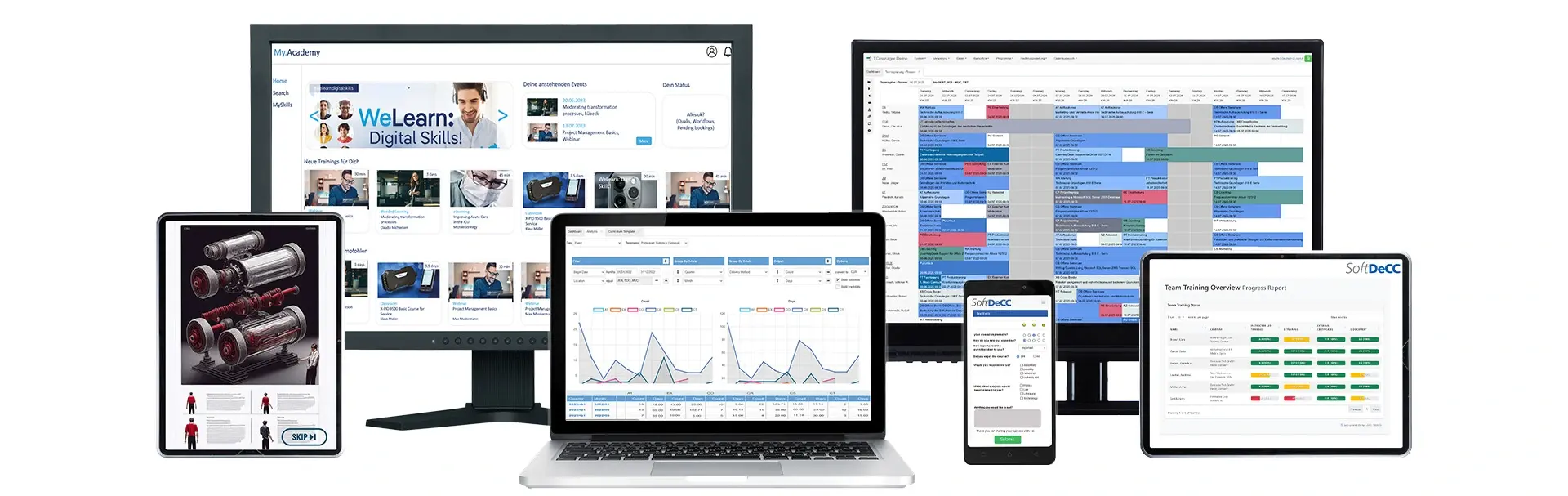
LMS Hosting Models Compared
Different organizations require different hosting strategies depending on IT maturity, compliance requirements, and scalability needs.
|
Hosting Model |
Key Benefits |
Typical Use Cases |
|
Cloud Hosting |
High scalability, low IT overhead |
Mid-market, global teams |
|
On-Premise |
Maximum data control |
Highly regulated industries |
|
Hybrid |
Flexibility + control |
Compliance-driven enterprises |
|
Managed Hosting |
Fully operated by provider |
Limited internal IT resources |
Cloud Hosting: Scalable Infrastructure for Modern Learning Platforms
In a Cloud Hosting setup, the LMS is operated in a professional external data center. Organizations access the platform via the internet, while infrastructure, updates, scaling, and maintenance are handled by the provider.
This model is especially effective for organizations with fluctuating learning demand, such as compliance training waves or global rollouts.
Key advantages:
- High scalability (automatic resource scaling)
- Low IT operational burden
- Predictable operating costs (OPEX model)
- High availability through redundancy and load balancing
For organizations in Germany and the EU, it is essential that data is processed in EU-based or German data centers, ensuring GDPR compliance and legal certainty.
Cloud hosting is particularly suitable for:
- mid-sized enterprises,
- globally distributed organizations,
- compliance-heavy training environments,
- companies with variable user demand.

On-Premise LMS: Maximum Control and Data Sovereignty
In an On-Premise LMS model, the system is hosted on internal infrastructure or company-owned data centers.
This model remains relevant in industries with strict regulatory or internal security requirements, such as:
- financial services,
- automotive,
- healthcare,
- public sector organizations.
The main advantage is full data sovereignty (data ownership and control).
Organizations benefit from:
- complete control over data storage and access,
- customized security policies,
- deep integration with internal systems (HR, IAM, SSO),
- full infrastructure governance.
However, this model requires significant internal IT capability:
- hardware investment,
- system maintenance and patching,
- backup and disaster recovery management,
- capacity planning and scaling responsibility.
On-Premise is best suited for organizations with strong internal IT departments and strict compliance requirements.
Hybrid LMS Hosting: Combining Cloud Flexibility with Local Control
The Hybrid Hosting model combines cloud scalability with on-premise control.
Sensitive data remains in internal systems, while scalable workloads are handled in the cloud.
|
Hybrid Scenario |
Business Benefit |
|
User data on-premise, content in cloud |
GDPR + scalability balance |
|
Cloud frontend, internal backend |
performance optimization |
|
Cloud used for peak loads |
flexible resource scaling |
|
gradual migration strategy |
reduced transformation risk |
Benefits:
- balance between scalability and data control
- lower migration risks compared to full cloud transitions
- improved flexibility for enterprise IT architectures
However, hybrid environments require clearly defined interfaces, responsibilities, and security governance.




Managed LMS Hosting: Fully Outsourced Operations
With Managed Hosting, the LMS provider operates the entire system on behalf of the customer.
This allows L&D teams to focus entirely on learning strategy, content, and training delivery.
Typical services include:
- hosting in certified data centers,
- system monitoring and maintenance,
- security updates and patching,
- backup and disaster recovery,
- incident management and support.
This model is particularly attractive for organizations without dedicated LMS infrastructure teams.
Security and GDPR in LMS Hosting
LMS platforms process sensitive personal data such as:
- training records,
- certifications,
- competency profiles,
- compliance documentation.
Therefore, security and regulatory compliance are central decision criteria.
|
Security Aspect |
Importance |
|
GDPR Compliance |
legal requirement |
|
Data Processing Agreement |
legal responsibility clarity |
|
Access Control |
data protection |
|
Backup & Recovery |
resilience |
|
Audit Logs |
traceability |
GDPR-Compliant Data Hosting in Germany and the EU
For organizations in the DACH region, data residency is often a core requirement.
Benefits of EU/German data centers include:
- stronger regulatory compliance alignment,
- simplified audit processes,
- reduced legal risk in cross-border data transfers,
- higher transparency in data processing chains.
Organizations should verify:
- where data is physically stored,
- whether subcontractors are involved,
- whether a Data Processing Agreement (DPA / AV-Vertrag) exists,
- whether data leaves the EU.
ISO 27001, Backup Systems and Disaster Recovery
Secure LMS hosting requires more than infrastructure availability.
Key standards include:
- ISO 27001 certified data centers
- encrypted data transmission
- role-based access control
- regular security patching
Equally important is a robust backup and disaster recovery (DR) strategy.
Core components:
| Aspect | Meaning |
| Backup |
data preservation |
|
Disaster Recovery |
system restoration |
|
Load Balancing |
traffic distribution |
|
Autoscaling |
dynamic scaling |
|
Service Level Agreement |
performance guarantee |
Cloud vs On-Premise: Decision Framework
Choosing the right LMS hosting model depends on organizational priorities rather than technology alone.
|
Business Requirement |
Recommended Model |
|
High data protection needs |
On-Premise / Hybrid |
|
Limited IT resources |
Cloud / Managed Hosting |
|
High usage fluctuations |
Cloud |
|
Deep system integration |
Hybrid / On-Premise |
|
Flexible cost structure |
Cloud |
For many enterprises in the DACH region, Hybrid Hosting offers the best balance.



FAQs: LMS Hosting Questions
What is the difference between Cloud and On-Premise LMS?
Cloud LMS is hosted in external data centers with high scalability. On-Premise systems run on internal infrastructure with full control over data and systems.
Is Cloud LMS hosting GDPR compliant?
Yes, if data is stored within the EU, a Data Processing Agreement exists, and appropriate security controls are implemented.
What is Autoscaling in LMS systems?
Autoscaling automatically adjusts computing resources based on user demand to ensure stable performance.
When should organizations choose Hybrid LMS hosting?When sensitive data must remain internal while still requiring cloud scalability.
Why is hosting location important?
Hosting in Germany or the EU improves legal compliance, reduces regulatory risk, and enhances performance for regional users.