


Skills Management in the Workplace—Now and in the Future
Skills Management Software: Basics, Features, and Benefits
Highlighting Skills, Filling Gaps
Organizations that systematically record and maintain qualifications ensure compliance, reduce audit risks, and strengthen their competitive edge. Qualification management makes competencies transparent, identifies development needs, and provides planning certainty in regulated industries.
Securing a Skilled Workforce
Audit Security
A Topic for the Future

Definition
What is competency management?
Competency management refers to the systematic planning, documentation, and management of employees’ competencies, skills, and certifications within a company. The goal is to provide transparency regarding existing qualifications, fill gaps, and strategically align development with the company’s objectives.
Unlike general skill management, qualification management places a greater emphasis on formalized record-keeping: Who has completed which training, which certifications are valid, and when do which qualifications expire? This transparency is particularly crucial in regulated industries and during audits.
Definition of Terms
Theoretical Foundations
What is important in qualifications management?
A structured competency-based approach forms the foundation of professional competency management. It is based on the assumption that an organization’s performance depends directly on the documented competencies of its employees.
Skills management thus serves as an interface between human resource management, knowledge management, compliance, and corporate strategy—it is not merely a database of continuing education courses.
Here's what you need:
Learning and Development Plans
Translate identified gaps into concrete, personalized, and strategically aligned actions. They link the results of the gap analysis and competency model to a binding schedule for training, certifications, or development meetings.
Update and Maintenance Processes
Qualifications lose their validity over time or are replaced by new requirements. A defined maintenance process ensures that competency models, matrices, and documentation remain up to date—rather than being collected once and then left to gather dust.
centralized · structured · audit-ready
Strategic Importance of Companies
Digital transformation, a shortage of skilled workers, and growing regulatory requirements make skills management a strategic leadership task. Companies that manage skills data only in Excel spreadsheets or fragmented systems lose track of the big picture—and their ability to respond quickly.
Professional competency management specifically addresses these challenges:
✓
Securing a Skilled Workforce: Identifying Key Skills and Developing Them Internally in a Targeted Manner
✓
Promoting Innovation: Systematically Building New Expertise in Fields Relevant to the Future
✓
Compliance and Audit Assurance: Providing Complete Documentation of Training and Qualifications—Even to External Auditors
✓
Supporting Transformation: Preparing Employees for New Roles and Changing Requirements in a Targeted Manner


Clarity for businesses. Opportunities for employees.
Compliance & Audit Security
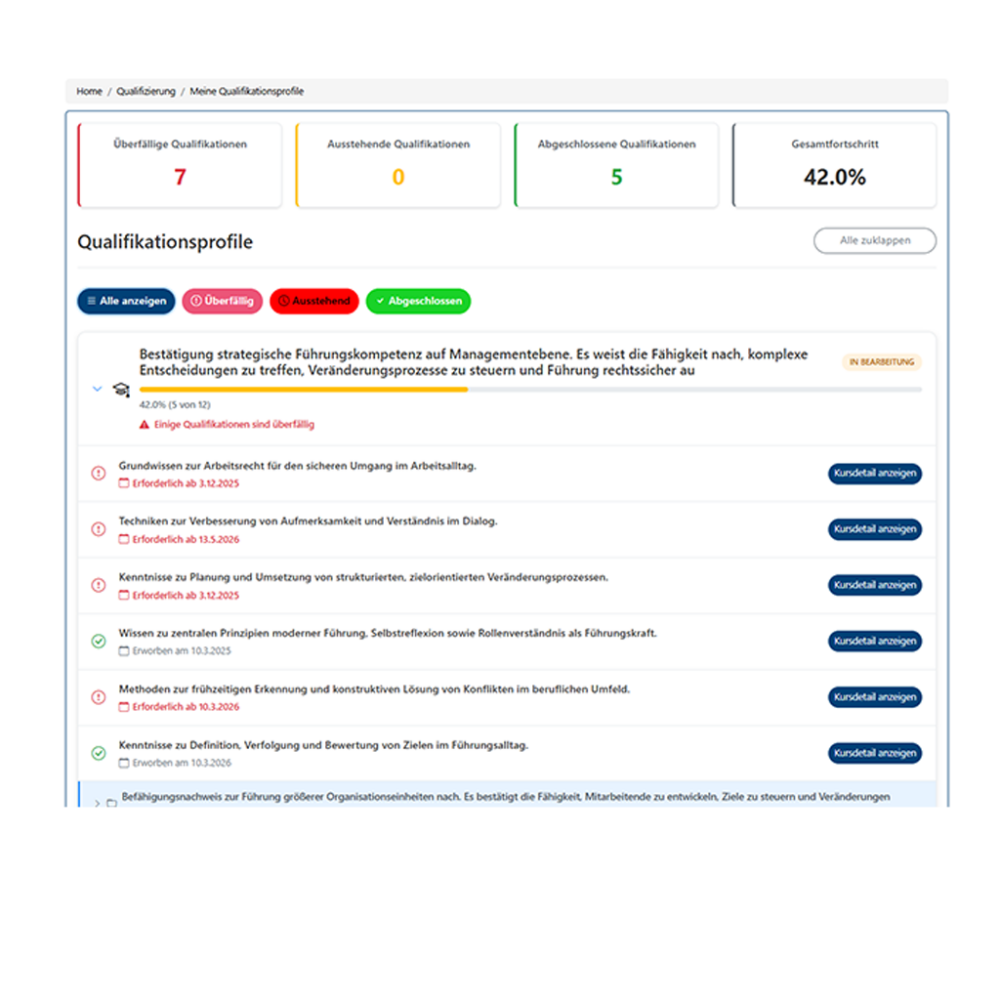
In regulated industries—from the automotive sector to financial service providers to training centers with AZAV certification—audit-proof proof of qualifications is not an option, but a requirement. Auditors verify whether training records are complete and traceable.Qualification management software automates this process: certificates of attendance are stored, certification expiration dates are monitored, and reminder workflows are triggered—all without manual effort. This reduces audit risks and protects against compliance gaps.
"Clarity for businesses. Opportunities for employees.
Benefits for Companies and Employees
Effective competency management operates on two levels—organizational and individual:
Organizational Benefits
For Businesses
✓
Planning Certainty: A clear, up-to-date overview of existing and required qualifications—accessible at any time, not just before the next audit
✓
Resource Efficiency: Avoid Duplication in Training, Allocate the Budget Strategically
✓
Compliance Protection: Automated process monitoring and audit-proof documentation minimize audit risks
✓
Competitive Advantage: Faster adaptation to technological and regulatory changes through targeted skills development
✓
Talent Management: Systematically Developing and Retaining Key Personnel
Individual Benefits
For Employees
✓
Transparency regarding one's own opportunities for development and skill level
✓
Targeted support through personalized learning paths based on actual skill gaps
✓
Greater Motivation Through Recognition, Opportunities, and Visible Progress
✓
Job security through proven, up-to-date, in-demand qualifications
✓
Easier role transitions or career advancement through documented, comparable skills

For which industries is competency management particularly relevant?
Competency management is valuable across all industries, but it is most effective in sectors where the obligation to provide evidence is mandated by law or standards:
• Automotive & Aerospace: stringent standards (e.g., IATF, EN 9100), end-to-end qualification management
• Pharmaceuticals & Medical Devices: GMP-, MDR-, and FDA-compliant documentation
• Banks & Insurance Companies: Regulatory Training Requirements, Including BaFin Guidelines
• Health Care & Nursing: Recertifications Requiring Documentation
• Certified Continuing Education Institutions (AZAV): Mandatory Compliance with Regulatory Requirements as a Prerequisite for Accreditation
Self-Service for Learners and Managers
Learning Portals as a Complement to Skills Management
The integration of learning portals into the digital learning landscape creates self-service structures for learners and managers alike.
For Students
✓
Easy access to courses and materials
✓
Independent learning at one's own pace
✓
Progress Bar
✓
Purchasing a certificate directly through the portal
For Executives
✓
Monitor the team's learning progress
✓
Plan targeted training initiatives
✓
Adapt training strategies based on current data
The integration of learning portals into the digital learning landscape creates self-service structures for learners and managers alike.
No-obligation consultation appointment
Informal discussions with experts
Discuss your use case with us. We’d be happy to answer your questions and highlight challenges and potential solutions.
✓
Over 25 Years of Expertise
✓
Made in Germany
FAQ
