.jpg)
How to Implement Article 4 in a Fully Auditable Way

Artificial intelligence is already embedded in enterprise environments — from HR systems and learning platforms to productivity tools and decision support systems.
Yet most organisations face a critical gap:
AI is in use, but AI literacy is not systematically governed or auditable.
This raises three urgent questions for L&D and HR leaders:
- What does Article 4 of the EU AI Act actually require in practice?
- Which employees must demonstrate AI literacy?
- How can organisations prove AI training in an audit-ready way?
This page explains how enterprises can operationalise AI literacy compliance — and how TCmanager® turns it into a structured, auditable process.
Regulatory framework: EU AI Act (EU Regulation 2024/1689), GDPR, German Works Constitution Act (§87 BetrVG) Status: 2026
What Article 4 EU AI Act requires in practice
Article 4 of the EU AI Act requires organisations to ensure sufficient AI literacy for individuals who operate, deploy or are affected by AI systems.
This is not a one-time training requirement. It is a context-specific, risk-based competence obligation.
Who is in scope
| Role |
AI literacy requirement |
|
Employees |
Basic understanding of AI use and risks |
|
Managers |
Ability to evaluate AI-assisted decisions |
|
HR / Recruiting |
Handling AI in high-impact HR processes |
|
L&D / Academies |
Structuring and evidencing training programs |
|
IT / Data teams |
Governance, risk and system oversight |
The real challenge for organisations
Most companies already run AI training initiatives, but:
- documentation is fragmented (Excel, PDFs, LMS exports, emails)
- no unified competence model exists
- no structured re-certification cycles
- no audit-ready reporting layer
- no linkage between roles, risks and training paths
👉 Result: training exists, but compliance cannot be proven.
What “audit-ready AI literacy” actually means
The EU AI Act does not define fixed curricula, but it requires verifiable and traceable competence structures.
Minimum evidence required for compliance
|
Evidence type |
Purpose |
|
Training assignments |
Who must complete what |
|
Learning pathways |
Role-based qualification structure |
|
Completion status |
Proof of training execution |
|
Assessments |
Evidence of understanding |
|
Certificates |
Formal documentation |
|
Re-certification cycles |
Maintaining validity over time |
|
Audit logs |
Full traceability of actions |

Why traditional approaches fail
- spreadsheets → not audit-proof
- isolated trainings → not scalable
- PDF certificates → not structured
- manual reminders → error-prone
👉 AI compliance fails not at training level, but at documentation architecture level.
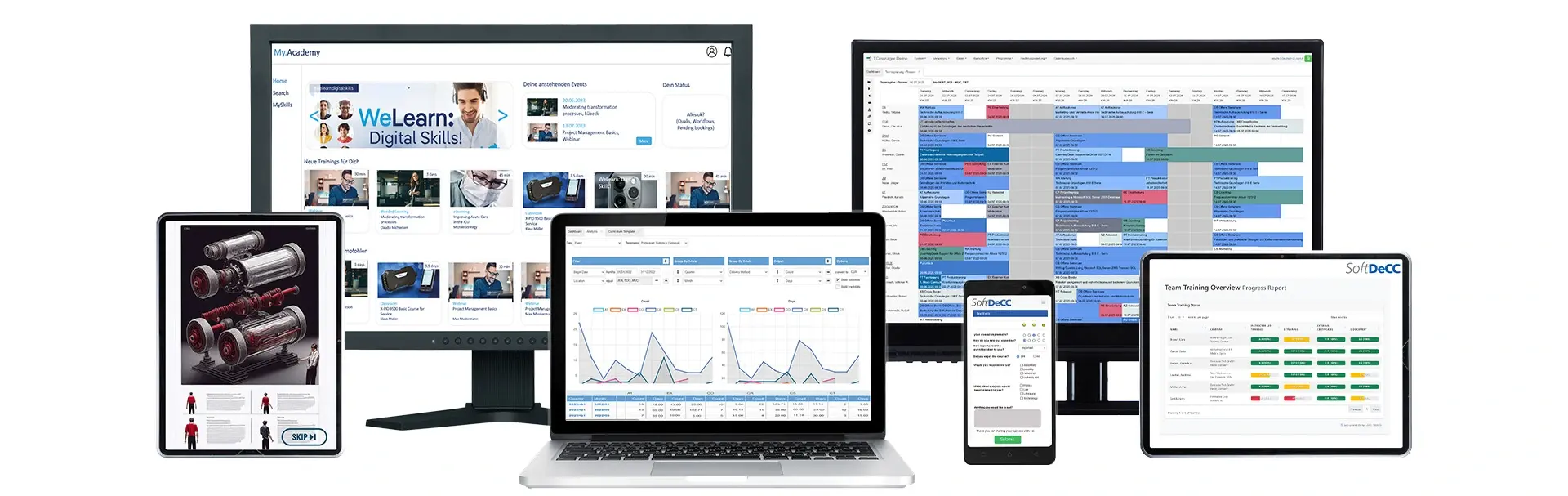
How TCmanager® operationalises AI literacy compliance
TCmanager® does not treat AI literacy as a reporting task, but as a fully structured governance and execution layer inside the LMS.
1. Role-based AI competence frameworks
AI literacy is structured by risk and organisational role:
- baseline training for all employees
- extended modules for leadership roles
- compliance training for HR functions
- governance modules for IT and data teams
👉 Learning requirements are automatically assigned based on role.
2. How it works in practice
Example: rollout of a new AI policy
- HR defines AI literacy requirements
- TCmanager® maps learning paths to roles
- employees are automatically assigned training modules
- completion is tracked and documented
- competence status is updated centrally
- re-certification cycles are scheduled automatically
👉 Result: no manual tracking required.
3. Auditability and compliance reporting
TCmanager® ensures AI literacy is fully traceable:
- complete audit logs of all learning activities
- exportable compliance reports
- timestamped certificates
- role-based visibility controls
- structured re-certification tracking
👉 AI literacy becomes not only trained, but provable.
4. Scalability for enterprise environments
For large organisations, the key benefit is operational scalability:
- centralised governance of all AI training
- consistent global rollout of compliance requirements
- automated updates when regulations change
- reduced manual HR and L&D workload



GDPR, Works Council and HR governance considerations
AI literacy data is personal data and often HR-sensitive.
Therefore, compliance requires alignment with GDPR and employee representation rules.
Works Council relevance (§87 BetrVG)
In Germany, Works Council co-determination may apply if AI systems:
- evaluate employee behaviour
- influence HR decisions
- or generate performance-related insights
👉 This includes AI-driven learning analytics in enterprise environments.
Recommended governance model
- inventory all AI systems
- classify risk levels
- define competence requirements
- design structured learning paths
- centralise compliance evidence
- establish audit processes
- involve HR, legal and Works Council early
Implementation roadmap for L&D and HR teams
| Step |
Objective |
|
Identify AI systems |
Create transparency |
|
Define roles |
Structure competence needs |
|
Deploy learning paths |
Standardise training delivery |
|
Centralise evidence |
Enable audit readiness |
|
Plan re-certification |
Ensure ongoing validity |
|
Establish governance |
Sustain compliance |
Frequently asked questions about AI literacy compliance
Is a one-time AI training sufficient?
In most cases, no. Organisations must demonstrate that AI literacy is maintained, updated and verified over time.
Who is responsible for AI literacy compliance?
Typically L&D and HR teams, often in collaboration with compliance, legal or IT governance functions.
How detailed must compliance documentation be?
The EU AI Act does not prescribe a fixed format, but requires structured, verifiable and traceable evidence of competence.
What role does an LMS play in AI literacy compliance?
An LMS provides the operational backbone for:
- training assignment
- learning pathways
- certification tracking
- compliance reporting
- re-certification cycles
Why is auditability critical?
Without structured evidence, organisations cannot demonstrate compliance, even if training has been conducted.


Operationalising AI literacy compliance with TCmanager®
TCmanager® enables organisations to move from training delivery to fully governed, auditable compliance structures.
Key benefits for L&D and HR
- automated role-based training assignment
- structured competence frameworks
- certification and re-certification workflows
- audit-ready compliance logs
- GDPR-aligned data architecture
- transparent governance processes
Designed for:
- L&D leaders
- HR compliance teams
- corporate academies
- regulated industries
- enterprises deploying AI systems at scale
📞 Your Free Consultation
Get personalized advice on the optimal implementation of your compliance and audit requirements.
Next steps:
- Schedule a live demo
- Review integration options
- Discuss industry-specific use cases
📞 Call +49 89 3090 839 30