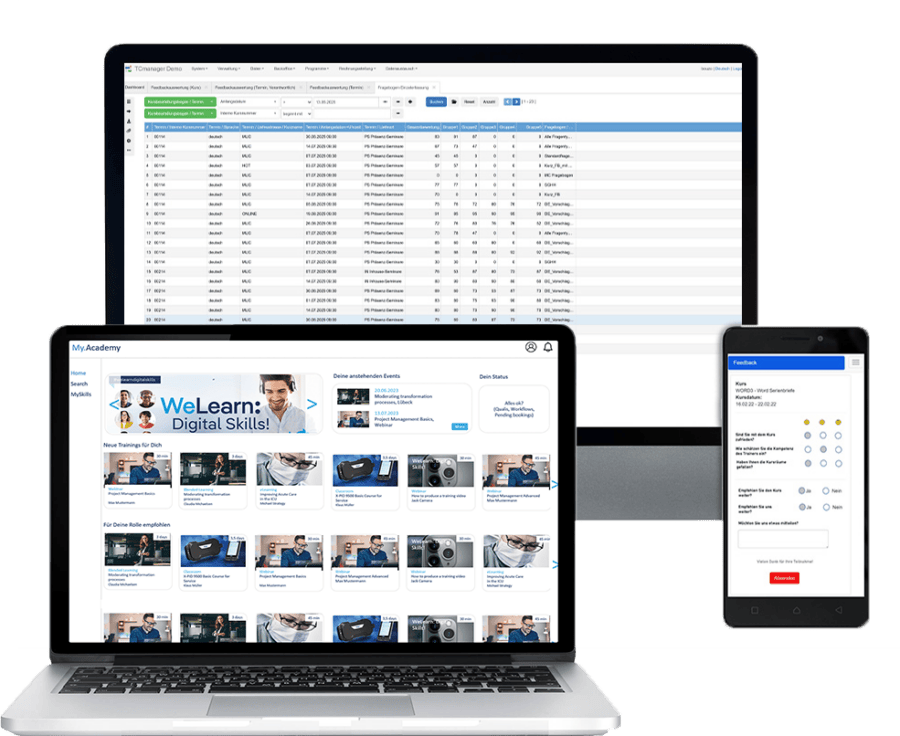
LMS Configuration: Roles, Workflows & White Label

Why a Customized Learning Landscape Makes the Difference

Standard LMS platforms work well as long as training processes remain simple. Once organizations introduce multiple locations, different target groups, international compliance requirements, or complex approval workflows, many systems reach their limits.

LMS configuration becomes necessary when a Learning Management System must support real business processes rather than simply delivering courses. This includes:

  • White Label LMS portals
  • LMS roles and permissions
  • Multilingual LMS environments
  • LMS workflows and automation
  • Scalable integrations and governance structures

This guide explains when LMS configuration becomes strategically important, which adjustments matter in practice, and what organizations should expect from a flexible LMS.

Krone Landmaschinen
capgemini
siemens
framatome

When Standard LMS Platforms Reach Their Limits

A standard LMS typically covers basic e-learning requirements: delivering courses, managing learners, generating certificates, and tracking participation. For small and homogeneous training environments, this is often sufficient.

More complex organizations require significantly more flexibility.

Flexible LMS Administration

Typical challenges:

Typical challenges arise when:

  • different departments require separate learning processes
  • customers, partners, and employees need distinct portals
  • regional compliance rules must be considered
  • approval workflows are required
  • international teams operate across languages and time zones
  • granular access control is necessary

In these situations, organizations often start managing processes outside the LMS using spreadsheets, emails, or additional tools.

The core issue is rarely missing features. It is the lack of adaptability.

Warning Signs: When the LMS No Longer Fits Your Business

An LMS has reached its adaptation limits when training managers start:

  • Running parallel Excel spreadsheets,
  • Sending emails manually,
  • "Bending" internal processes to fit the system – instead of the other way around.

At this point, the system becomes a blocker rather than an enabler.

Which Customizations Actually Matter in Practice

Not every requirement justifies customization. And not every customization is equally complex. In practice, four configuration dimensions determine the success of an LMS project.

White Label LMS and Branded LMS: Brand Capability and Portal Logic

A White Label LMS – also called a branded LMS – enables full adaptation of a learning platform to your brand.

Companies training customers, partners, resellers, or external audiences often specifically look for a White Label LMS because standard platforms frequently look too much like software vendor products, weakening brand impact.

A branded LMS typically includes:

White Label LMS Feature

Benefit

Own corporate design

Consistent brand experience

Custom domains

Professional brand presence

Logos and color schemes

Higher brand recognition

Separate learning portals

Audience-specific academies

Multiple brand environments

International or decentralized organizations

Sepearation by target group

Separation of customer or partner data


A White Label LMS affects not only appearance. It improves:

  • brand perception
  • trust
  • user acceptance
  • customer retention
  • scalability of training offerings

A branded LMS is especially relevant for:

  • partner academies
  • customer portals
  • franchise structures
  • international training organizations
  • certification programs

A modern White Label LMS should be fully configurable and update-safe, without changes to the source code.

LMS Roles and Permissions: Data Protection and Governance

LMS roles and permissions define who can see, edit, or manage which data.

In simple training environments, standard roles are often sufficient. Complex organizations require granular permission concepts.

Typical requirements include:

  • regional data separation
  • role-based dashboards
  • restricted learner access
  • different administrator rights
  • GDPR-compliant visibility
  • auditable change logs

A flexible LMS allows configuration of permissions across multiple levels:

  • user groups
  • locations
  • departments
  • courses
  • fields
  • functions

International companies often need a differentiated permission concept. If a training manager in Europe can access sensitive data from a US site, a compliance risk emerges quickly.

LMS roles and permissions are therefore not just convenience features. They are governance and data protection instruments.

LMS Workflow: Automating Training Processes

An LMS workflow describes automated process chains within a Learning Management System. Instead of manually organizing approvals, reminders, or certificates, the LMS handles recurring processes automatically.

A typical LMS workflow looks like this:

Booking → Approval → Confirmation → Reminder → Participation → Certificate

In complex training organizations, workflow automation significantly reduces errors, administrative effort, and compliance risks.

LMS Workflow Function

Value

Approval workflows

Compliance-compliant releases

Reminder logic

Fewer no-shows and missed deadlines

Escalation rules

Early response to delays

Certificate automation

Complete documentation


LMS workflows become especially relevant for:

  • compliance training
  • mandatory instructions
  • recertifications
  • international training organizations
  • partner and customer training

A configurable LMS allows adaptation of process logic without programming. Training processes then rely less on manual initiative and more on reproducible, auditable workflows.

A multilingual LMS supports different languages for learning content, user interfaces, and communication.

Professional internationalization goes far beyond simple translations.

A flexible LMS also considers:

  • course language vs learner language
  • regional holidays
  • time zones
  • currencies
  • local compliance requirements
  • language-dependent notifications
  • international rollouts

Global companies often need regional learning portals with different regulatory requirements.

Examples:

  • GDPR in Europe
  • FCPA in the USA
  • industry-specific safety regulations
  • local certification requirements

A multilingual LMS ensures training remains locally relevant while global processes stay centrally controllable.

dräger
innio
deutsche bahn
yaskawa

When Is LMS Configuration Strategically Necessary?

LMS configuration becomes necessary when at least one of these three conditions applies:

  1. Different user groups need different views of the same data.
  2. Internal approval processes should be automated.
  3. The system must operate in more than one language or for more than one business unit.

When Is Standard Configuration Enough – and When Is It Not?

Small companies with a homogeneous training offering and a single admin team often work fine with default LMS settings. However, once approval levels, different portal access for customer groups, or automated correspondence come into play, individual configurations become economically necessary – not as a luxury, but as a prerequisite for operational reliability.

Decision Matrix: Configuration Needs at a Glance

Situation

Recommendation

Rationale

One location, one language, one target group

Standard configuration sufficient

Low differentiation need

Multiple departments, each with own learning paths

Role & permission configuration

Data separation and clarity required

External training customers or partner portals

White label & portal logic

Brand consistency and data isolation

Approval required for bookings

Workflow configuration

Compliance and traceability

Multiple countries, languages, or regulations

Full internationalization

GDPR, FCPA, etc. require local mapping


Made in Germany
Iso Certification
hosted in Germany
made in Europe

What a Configurable LMS Architecture Must Deliver

  • Central Configuration: Comprehensive settings palette for precise control across all system areas – no programming skills needed.
  • Quick Development Cycles: Regular updates with new functionalities and customization options. The system grows with the market.
  • Open System Integration: API, REST, SCORM, xAPI – seamless connection to HR, ERP, CRM, and payment providers.
  • Performance at Scale: High speed and reliability even with rising participant numbers – globally and locally.
  • GDPR & Compliance: Role-based permissions, complete audit trail, anonymization functions – compliance built-in.
  • Modularity: Add or remove building blocks as needed – without touching the overall system.

Operational Independence as Core Value

LMS configuration is well-implemented when training managers can make changes independently – without developers, without tickets to the vendor. Operational independence is the actual value added, not the configuration option itself.

Conclusion: Adaptability as a Strategic Asset

Companies change continuously:

  • new locations
  • new target groups
  • new compliance requirements
  • new processes
  • new technologies

An LMS must be able to support these changes. LMS configuration is therefore increasingly becoming a strategic factor.

A flexible LMS enables:

  • White Label learning portals
  • granular roles and permissions
  • automated LMS workflows
  • international training organizations
  • multilingual learning platforms
  • scalable training processes

The decisive question is no longer:

"What functions does the LMS have?"

But:

"How well can the LMS adapt to our processes?"

Free Consultancy Appointment

Our experts analyze your requirements and show you concrete configuration options.

Discuss your challenges with us! We are happy to share our experiences with you and support you in your project.

Call us now at: +49 89 3090 83930

FAQ – LMS Configuration

What is LMS Configuration?
LMS configuration is adapting a Learning Management System to business processes without custom development. Includes: LMS roles and permissions, LMS workflows and automations, white-label learning portals, multilingualism and localization, reporting, dashboards, permissions. Advantage: Companies adapt LMS to processes without changing source code – updates remain possible, adaptations scalable.

When is LMS Configuration Necessary?
LMS configuration becomes necessary when training processes are more complex than standard LMS logic. Organizational complexity matters, not company size. Configurable LMS useful for: multiple user groups (employees, customers, partners), approval workflows, multiple countries/languages, different roles/permissions, compliance training. Indicator: When training managers run parallel Excel spreadsheets, standard LMS reaches limits.

Difference Between LMS Configuration and LMS Customizing?
LMS configuration uses existing system parameters; LMS customizing develops new functions. Configuration: roles/permissions, workflow control, white-label branding, language versions, notifications, process logic. Customizing starts with new programming e.g., proprietary interfaces, individual business logic. Flexible LMS reduces customizing need because many requirements implemented via configuration.

What Makes a White-Label LMS?
A white-label LMS enables complete learning platform adaptation to your brand. Typical functions: corporate design, individual domains, logos/color schemes, brand-specific learning portals, separate academies for customers/partners. Especially relevant for companies training external audiences (Extended Enterprise) and creating consistent brand experience – e.g., partner academies, customer training.

Why Are LMS Roles and Permissions Important?
LMS roles and permissions control who can view, edit, or manage which data. Granular configurable rights concept improves: data protection, governance, auditability, data quality, clarity. Regional training manager should only access relevant locations/audiences. In international organizations, roles/permissions quickly become a compliance topic (GDPR, audit-ready documentation).

What is an LMS Workflow?
An LMS workflow describes automated process chains within a Learning Management System. Typical workflows: booking → approval → confirmation → reminder → participation → certificate. Workflow automation reduces: manual administrative effort, errors in training processes, forgotten reminders, missing proofs. Configurable workflow ensures reproducible, audit-ready, scalable processes, essential for compliance training.

How Does LMS Flexibility Impact Total Cost of Ownership (TCO)?
A flexible, configurable LMS reduces long-term TCO because adaptations are possible without programming. Customizing is expensive, complicates updates, requires maintenance. Configuration remains low-maintenance, update-safe, scalable. Companies save implementation costs, reduce outsourcing, keep process control internally. Flexibility determines whether LMS can grow with the company.

Which Configuration Functions Are Critical for International Companies?
Critical for international organizations: multilingual UI and content, regional role models, location-specific permissions, different time zones/currencies, local compliance requirements. Parallel multilingualism without translation effort, separate learning portals per region, central reporting with regional filtering enable global control with local relevance. GDPR-compliant hosting in the EU mandatory for European companies.


Recommendations